Like every household, our home has its focal points of argument. Sometimes it’s about chores, sometimes it’s about who will clean the spilled water, and very often it’s the classic: “Where is my ball? I kept it right here!”
While discussing democracy and government with my son recently, I threw out a casual suggestion: “Why can’t we run our home like a democracy?”
My son’s eyes lit up. He immediately started throwing in ideas from our freshly baked conversations:
- When friends come over, we vote on what to play.
- Let’s keep a ballot box for every conflict!
- Everyone should vote for the menu of the week.
He even started categorizing our home into “Government Departments”: Buying, Housekeeping, Cooking, and Chores. We weighed the pros and cons, feasibility was a big topic! Our biggest hurdle? “How do we involve Nana, Nani, and Masi who don’t live with us?”
The “Weekly government” experiment
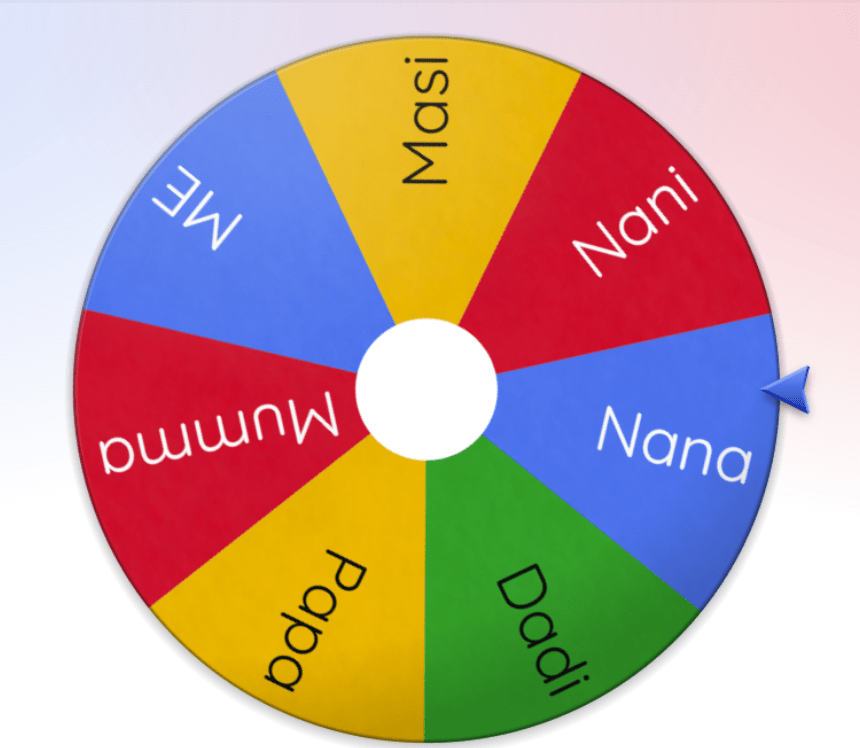
After much debate, we landed on a system: Every week, one person is the “Family Government.” That person decides on one or two tasks that everyone in the family must do. If you fail, there are consequences. Every Friday, the government changes via a spin-wheel. To keep the Nana-Nani and Masi involved, we appointed a “Reporter of the Week” to “audit” their home via message to ensure the “laws” were being followed.
What our government actually did
When it was time to govern, the “agendas” became very clear. Here are some of the mandates we ran during those weeks:
- Everyone had to fold their own clothes and wash their own vessels immediately after meals.
- Every family member had to do 10 minutes of Pranayama and two yoga postures daily.
- A strict “No Raised Voices” policy was enacted across the house.
- Every day, you had to find two good things about every family member and tell them directly.
Reflections from the few weeks of democratic home
We survived few weeks of this change and the observations have been fascinating (and hilarious):
- While I focused on yoga and vessels, my son’s “Buying Department” had a different priority. When he was in charge of the weekly grocery list, there was a sudden, increase in the number of chocolates and biscuits entering the house!
- Every Friday, my son wakes up with a burst of extra energy, racing to the spin-wheel to see who holds the power next.
- My son became a master observer. He was almost always the Reporter (unless he was the leader). He would diligently message Nana and Nani to check if they had done their yoga or folded their clothes.
- Poor Dadi was constantly being hovered over; the “Government” wanted to make sure she wasn’t faltering on her duties!
- My son would secretly hope the wheel didn’t pick me, because he knew my “laws” would be tough. On the flip side, he secretly hoped Papa would forget a task so he could finally “set the score equal” with a consequence!
- I saw him doing complex mental calculations to make a system work across two different houses. He wasn’t just “playing house”; he was conceiving a social system.
Why this matters
Looking back, this experiment did so much more than just get the chores done. It made the hidden layers of our thinking visible.
- Seeing the Child’s World: The chocolate-heavy grocery list wasn’t just about sweets; it was about him realizing he finally had the agency to influence his environment.
- Role Reversal: Seeing a child “police” an adult’s behavior shifts the power dynamic. It showed us how it feels to be on the receiving end of a rule, and he experience the responsibility comes with power.
- Thinking Skills: When the “consequences” were too harsh, we had to negotiate. This wasn’t a tantrum; it was a thinking skill.
This experiment didn’t solve all our arguments, but it gave us new perspectives like – finding the joy in the chocolates, even when you’re looking for the yoga.